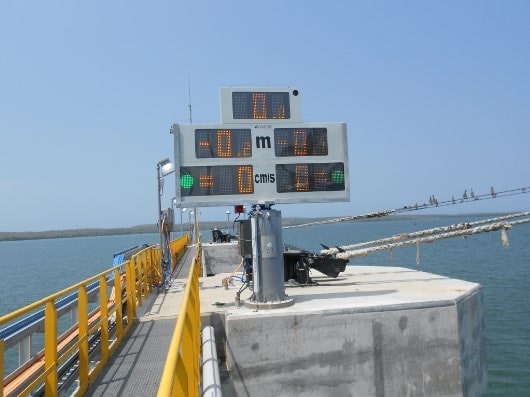
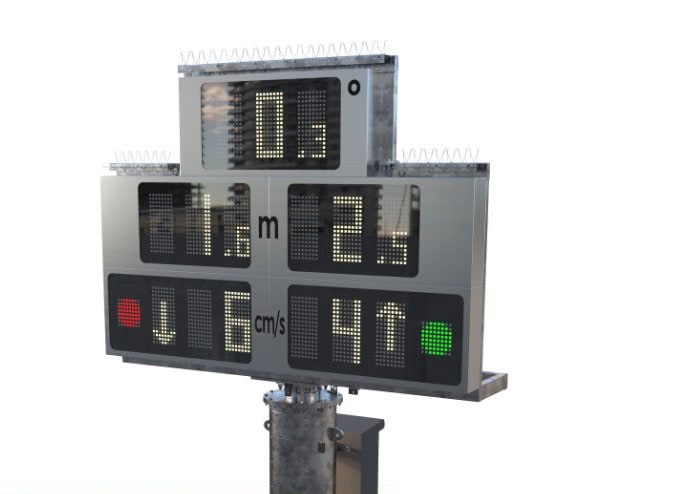
The Berthing Aid System (BAS) is a visualization tool that gives real-time data on maneuver status. With this system in place, operators gain enhanced information, making it easier for them to take corrective measures if the set limits are exceeded. This system monitors berthing and mooring at maritime terminals, providing information to simplify operations and guarantee secure ship berthing.
The Berthing Aid System utilizes laser technology to measure the distance between the dock and an approaching vessel’s side. It provides real-time data on distance (both Bow and Aft), speed of approach, and angle, accessible on a standard PC and a large LED display. Moreover, the LED display can showcase critical parameters like wind speed, current, and wave conditions, and other essential data.
Prosertek Berthing Aid System
Suprabakti Mandiri guarantees a simplified berthing process by providing Prosertek’s Berthing Aid Systems. With over two decades of expertise, Prosertek specializes in maritime ship docking and delivers globally used products.
Dockmoor software, developed by Prosertek, offers an innovative Berthing Aid System (BAS). The information provided by Dockmoor can be accessed on several platforms, including digital panels on the dock, remote laptop monitors, control room displays, or website remote access.
Benefits of Dockmore Berthing Aid System on Marine System:
- Minimize operational expenses and mitigate damage to the berth, fender, and ships
- Enhance control over the safety and protection of the surroundings
- Real-time monitoring, data recording, report generation, and historical data analysis
- Facilitate the analysis of various variables involved in berthing
Dockmoor modules
Available modules that Suprabakti supplies:
Dockmoor – BM.
Berthing and unberthing monitoring
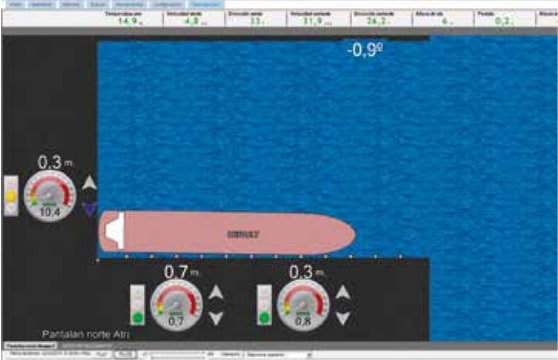
The Dockmoor-BM module facilitates precise measurement of ship distance, bow-to-stern speed, and angle concerning the port fender system. These metrics create a real-time scale image of the vessel, its maneuvers, the dock, and fenders. Configurable alerts and historical data enable analysis for berthing process enhancements.
Dockmoor – MS
Mooring stress monitoring
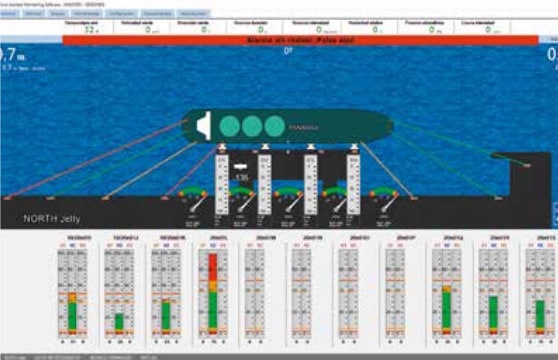
The Dockmoor-MS module oversees a crucial aspect of the mooring process by measuring the tension endured by the mooring lines. It considers factors like rope tension, hook status, and fender compression.
Integrated load cells in quick-release mooring hooks enable real-time data monitoring and alarm setup for overload warnings. Additionally, customizable configurations cater to specific customer requirements, and this module can be integrated with other complementary modules
Dockmoor – RR
QRH remote release control
The Dockmoor-RR module comprises interactive screens and a control desk for monitoring and managing all Quick Release Hooks (QRH). It includes essential components for hook release, such as cables, communication boxes, actuators, and control panels, making it a comprehensive and advanced installation. Configurations allow for single or multiple hook releases, including emergency release options, all controlled from the central command room.
Dockmoor – ER
Weather conditions monitoring
The Dockmoor-ER module offers versatile configurations, from small sensors to compact weather stations, adept at analyzing environmental parameters and producing real-time data visualization.
It helps monitor parameters like ambient and water temperature, wind speed and direction, wave height and frequency, humidity, and atmospheric pressure. Moreover, it can suit specific facility requirements by incorporating additional measurements such as visibility and solar radiation levels.
Dockmoor – FP
Fender protection monitoring
The Dockmoor-FP monitors fender deflection during the final stages of berthing and docking. It captures, visualizes, and stores real-time parameters, issuing alerts for any excessive deformation of individual fenders. Displaying deflection value, energy absorption, and reaction force on charts or graphs provides data analysis for effective decision-making.
It communicates with devices, executing manufacturer-defined commands, and supports lasers, loading arms, load cells, trip desks, weather sensors, oceanographic sensors, and variable message signs (VMS).